Starting in Foundation 2 at St George's
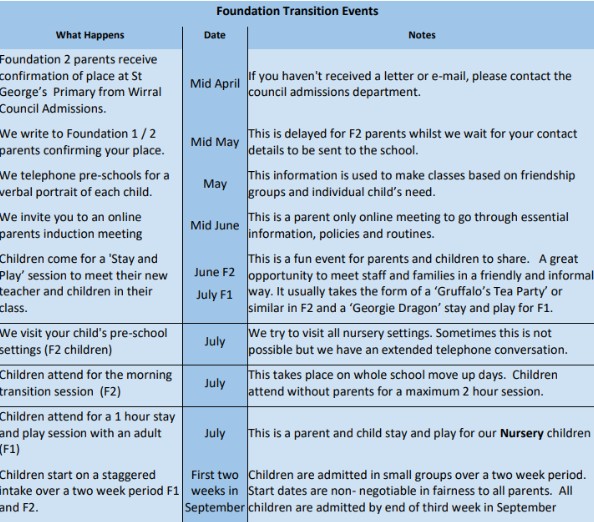
We look forward to welcoming your child into Foundation 2 at St George's. This is the timetable for transition.
Before they arrive in September, here are some helpful hints and tips for preparing your child for Foundation 2.
Transition-in-Foundation-2 (ID 1074)
-
Starting Foundation 2 Checklist
Starting Foundation 2 Checklist
-
Growing Independance
Growing Independance
Taking care of themselves
- Putting on/taking off their coat and shoes
- Using the toilet and washing their hands
- Getting dressed with little help, e.g. after using the toilet or doing PE
- Using cutlery (e.g. fork and spoon, chopsticks) and drinking from an open cup
- Spending time away from you, learning they can be looked after by caring adults
Play, creativity and curiosity
- Taking part in imaginative play (e.g. role play)
- Drawing, painting, colouring and sticking
- Counting, building and doing puzzles
- Sharing story books with caregivers, looking at pictures and talking about the characters
- Exploring the world around them (e.g. looking closely at the natural world, noticing numbers, patterns and shapes, playing safely with objects at home)
-
Building relationships and Communicating
Building relationships and Communicating
Being with others
- Practising sharing and taking turns with toys
- Talking to them about how they are feeling and why
- Looking at story books together and speaking about what characters are feeling is a good way to do this
- Beginning to recognise what others are feeling, e.g. understanding if a friend is sad
- Encouraging them to set boundaries for themselves and others (e.g. knowing how to say ‘no’)
Communication and language
- Singing along with songs and nursery rhymes
- Talking happily to others about activities, experiences and the world around them
- Showing they need help by speaking clearly (in basic English or sign language)
- Recognising the pattern of their name (so they can find it on their coat peg or jacket)
Listening and engaging
- Paying attention for short periods of time
- Listening to and following simple instructions
- Carrying on with a task even when it’s difficult and bouncing back if things go wrong
-
Physical Development
Physical Development
Getting moving for at least three hours a day
- Walking up and down steps (one foot at a time, using the wall for support)
- Climbing, running, jumping and playing
- Catching a large ball (most of the time)
- Doing simple puzzles and craft activities, strengthening their grip with cutting and sticking
-
Healthy Routines
Healthy Routines
- Going to bed around the same time each night, waking up in time to get ready for school
- Limiting screen time to the recommended daily amounts (see advice)
- Eating a healthy diet and trying new foods
- Brushing their teeth with fluoride toothpaste twice a day (you’ll need to supervise this until they are at least 7)
For more details you can click on the link below:
https://startingreception.co.uk/wp-content/uploads/2025/03/Starting-Reception.pdf
F2 expectations:
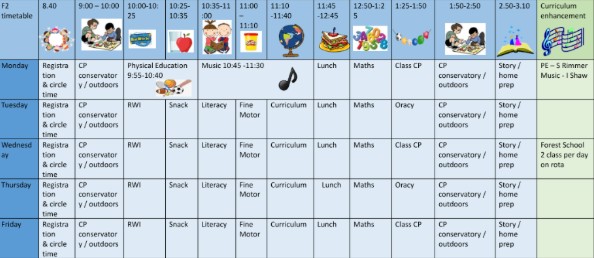
Timetable - what a day looks like:
The daily timetable and EYFS environment changes throughout the academic year in response to the children’s needs and stages of development. When children first join the setting in both F1 and F2 they access greater amounts of unstructured time in which to explore their environment and make relationships with new friends.
Adult-directed time is kept to a minimum and predominantly delivered via small group situations. As children develop their concentration and listening skills, adult-led activities increase appropriately – whilst still maintaining a strong focus on children’s learning through play, via effective continuous provision and high-quality, sensitive adult interactions.