
Promoting Good Health and Managing Illness
Promoting good health and well-being is vital to our work at St George's. We do this through:
1. Our curriculum. We promote physical health, emotional health and resilience across our curriculum.
2. Promoting daily exercise and opportunities for sports and well-being in our community.
3. Promoting our 'eat-well challenge'.
4. Working with families and other agencies with support for physical health, sleep, toileting, mental health, emotional well-being, dental health and lots more!
5. Having robust processes in place to support children with medical needs and the management of medication (if needed)
6. Encouraging a safe, healthy environment through:
- Effective cleaning
- Good hygiene
- Good ventilation.
Families may also wish to visit our:
Medical Care and Medication Policies Page
Health Watch Wirral pastoral link
Managing Illness
Working together we can help our children to be healthier, happier and manage illnesses. Video below explains how parents can make decisions regarding their child's illnesses and whether they should attend
school.
NHS has also produced a helpful chart that we can use for decisions on managing illness. This can be read by clicking on the document below. There is further information available on: NHS - Is my child too ill for school? website page.
nhs guidance sheet illness parents.pdf
There is a lot of information for schools and families regarding how we stay healthy and manage illness. These include:
Education Hub Blog: Reducing the spread of illness this winter: Seven steps to healthier schools and higher school attendance.
- NHS Guidance for Parents: Is my child too ill for school? – a useful resource to help parents decide when children should stay at home.
- Preventing and Controlling Infections Guidance: Includes advice on vaccination, ventilation and good respiratory hygiene.
- A–Z of managing Infectious Diseases: Practical guidance on managing specific illnesses.
Minor illnesses are normal. We need to help our children manage these and develop the resilience that we need to be healthy and happy.
If your child is seriously unwell, refer to the guidance above, contact your GP or use the NHS 111 service.
If you would like to speak with a member of our team, please complete our contact us form.
Coughs and Colds
It's fine to send your child to school with a slight cough or common cold symptoms, such as a runny nose, sore throat or headache, as long as they're otherwise well and do not have a high temperature.
But if they have a high temperature, keep them off school until the temperature has gone.
Feeling Anxious or Worried
It's normal for children to feel a little anxious sometimes. They may get a tummy ache or headache, or have problems eating or sleeping.
Avoiding school can make a child's anxiety about going to school worse. It is important that we teach children that the adults are here to look after them and help address anything that is causing them anxiety.
It's good to talk about any worries they may have, such as bullying, friendship problems, school work or sensory problems. You can also work with the school to find ways to help them.
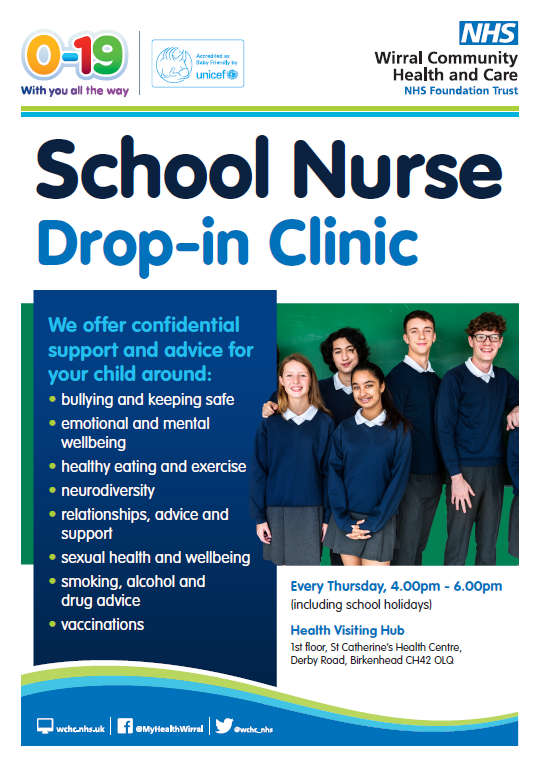
If your child is still struggling and it's affecting their everyday life, it might be good to talk to your GP or attend a Wirral school nurse drop-in session (See below)
Find information and advice about how to help children with anxiety
Vaccinations
Working with our colleagues at Wirral Council and Wirral Community NHS Trust, we promote vaccination for protection. Vaccination is one of the most powerful evidence-based measures that protects against preventable illnesses.
- School Age Immunisation Services (SAIS) will deliver free flu vaccinations to all school children in England (from reception to year 11) at school every Autumn.
- We encourage anyone with questions or concerns to speak to a health visitor, school nurse, GP or the SAIS team 03333 583 397 option 7 then 2
- Further information can be found at: Children's flu vaccine - NHS
We fully acknowledge that families have the right to make personal choices about vaccinations, but just ask that these are informed. There is a lot of misinformation regarding vaccination.
We know that many parents may have questions regarding the flu vaccination and how this is administered. Mr Cassidy and school governors must follow: .Gov.Uk Flu Vaccination guidance on this matter.
As per DfE advice, we are not legally permitted to authorise absences due to vaccinations.
Want to know more?
- Schools are mandated to administer vaccinations. These are administered in Autumn term and families are notified and have to give their consent. DfE Guidance can be read in full by clicking here. This link explains the technical notes for each vaccine.
- Senior leaders and governors fully support the program. We know it is important for our children to have vaccinations.
- Planning for this starts in the summer term. We receive extensive guidance and support from public health on this. This includes a school based risk assessment.
- We respect that some parents may have different views and seek to share vaccination dates and process for exercising parental choice as early as possible.
Q1: What measures, if any, does the school take to minimise potential exposure to vaccine virus for children who have not received the vaccine?
Explicit advice is that shedding risk is minimal. However, we undertake a rigorous control and risk assessment process to ensure that vaccinations are:
- Administered away from classrooms and eating spaces.
- We create a privacy screen for administration of vaccinations.
- Appoint a nominated supervisor who works with NHS staff
- Establish separate waiting areas away from vaccine administration area. This means pupils are only in the area for a short period of time.
- All areas are well ventilated with hand washing and hygiene controls. All areas are also deep cleaned after any medical administration.
This is the best link to summarise advice shared with parents and schools:
https://www.nhs.uk/vaccinations/why-vaccination-is-important-and-the-safest-way-to-protect-yourself/
Q2. Does the school or immunisation provider have any specific guidance or arrangements for children who are not receiving the nasal vaccine but whose parents have concerns about exposure to vaccine virus shed by vaccinated children?
Yes. That advice is in the links above. Advice is that there is minimal risk of shedding and beyond controls for administering vaccines there are no further steps necessary apart from monitoring for any allergy responses. The Department for Education specifically states that parents cannot lawfully withdraw their children from school because they express a concern about this risk.
Guidance also explicitly states that “If parents or carers have questions on the suitability of the vaccine for children, they should speak to the NHS team delivering the vaccination”. We are happy to answer your questions but do so from a lay person’s perspective. NHS contact details are above.
Q3. Can you keep children separate during or immediately following the vaccination session?
This is not required. Details relating to risk and shedding are in the links above.
Q4. Can I keep my child off school if I don't want them to be around children who have been vaccinated? No, unless your child or somebody in your family has a significant immunity health related concern. This will be an unauthorised absence. We have taken the stance to respect that there are different views on vaccinations but :
- Government has stated this not a lawful reason for school absence.
- We are are clear that the vaccination process does not present a health risk to other children.